
Smart rings have moved from novelty gadget to mainstream wellness tool faster than most people expected. But there is a persistent misconception spreading through fitness communities and health forums: that the data these devices produce is equivalent to what a doctor’s office or sleep lab would measure. It is not. Consumer smart rings are estimators, not direct medical instruments, and independent clinical evidence shows variable accuracy for metrics like sleep stage classification compared with polysomnography (PSG). This article breaks down what smart ring health technology actually is, how it works, how accurate it can be, and what you should realistically expect from it.
Table of Contents
- What is smart ring health technology?
- How do smart rings measure your health?
- Smart rings vs. clinical measurements: How accurate are they?
- Making the most of smart ring health tracking
- A candid take: What most guides won’t tell you about smart ring health tech
- Experience the future of personal health with smart rings
- Frequently asked questions
Key Takeaways
| Point | Details |
|---|---|
| Smart rings track trends | Smart rings are valuable for observing wellness patterns, not for making clinical diagnoses. |
| Multiple sensors inside | These rings combine optical, temperature, and motion sensors to gather daily health data. |
| Accuracy limitations | Expect reasonable trend accuracy, but measurements are influenced by position and device limits. |
| Maximize through smart use | Best results come from consistent wear and focusing on long-term patterns rather than singular data points. |
What is smart ring health technology?
Smart ring health technology refers to the integration of miniaturized biosensors, signal processing algorithms, and wireless connectivity into a ring-sized wearable device. The goal is continuous, passive monitoring of physiological signals throughout the day and night. Unlike a smartwatch, which sits on the wrist and can accommodate a larger battery and display, a smart ring operates within tight constraints of size and power, which directly shapes what it can and cannot do.
At its core, smart ring health tech is the combination of optical pulse sensing (PPG) for cardiovascular-related signals, temperature and motion sensing, and signal processing or modeling that converts noisy, user-dependent measurements into stable daily scores and trends. PPG stands for photoplethysmography, which is a method of detecting blood volume changes in tissue using light. The ring shines light into your finger and measures how much bounces back. Changes in that reflection correlate with your pulse.
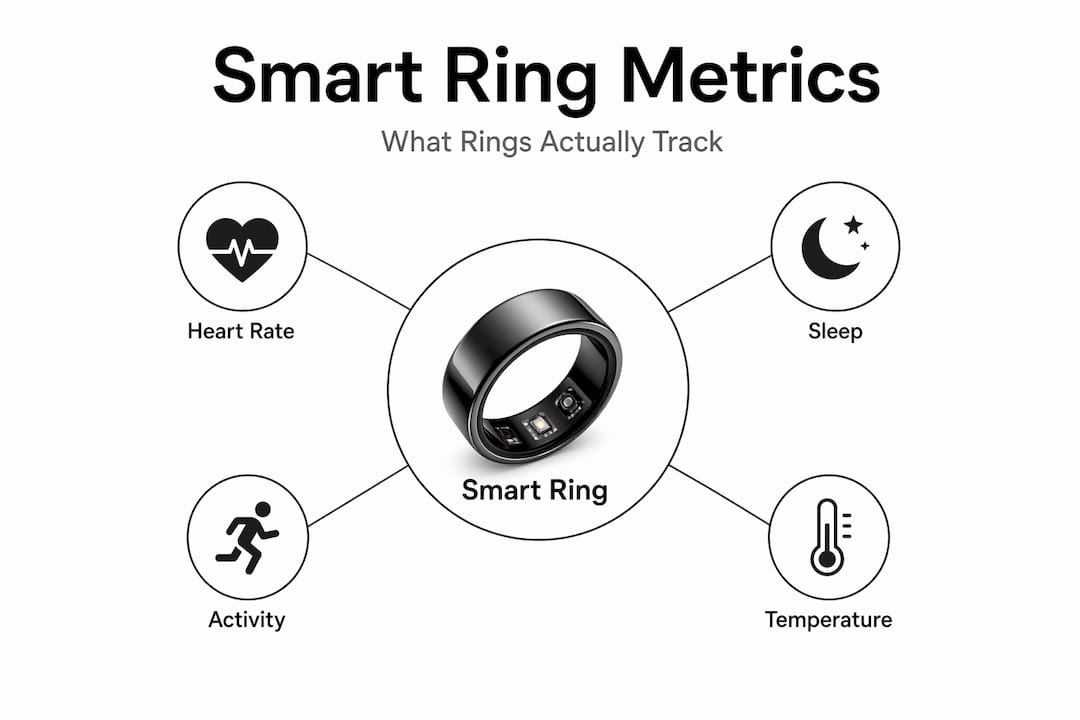
Common health metrics tracked by smart rings:
- Heart rate and resting heart rate
- Heart rate variability (HRV)
- Blood oxygen saturation (SpO2) on select models
- Sleep stages (light, deep, REM)
- Skin temperature and temperature variation
- Step count and activity level
- Respiratory rate during sleep
- Readiness or recovery scores (composite metrics)
The following table shows the primary sensor types found in most consumer smart rings and what each one measures:
| Sensor type | What it measures |
|---|---|
| PPG (optical) | Heart rate, HRV, SpO2, respiratory rate |
| Accelerometer | Movement, step count, activity intensity |
| Infrared thermometer | Skin surface temperature, temperature trends |
| Gyroscope (some models) | Ring orientation, motion quality |
The ring form factor matters more than most buyers realize. The finger has a dense network of capillaries close to the skin surface, which gives PPG sensors a strong, clean signal compared to the wrist. Less ambient light interference and less involuntary muscle movement during sleep make the finger an excellent measurement site. This is one reason why well-fitted smart rings can produce surprisingly reliable resting heart rate data under controlled conditions.
Pro Tip: Fit is not just about comfort. A ring that is too loose will rotate on your finger, shifting the sensor away from the optimal position and degrading signal quality. Size your ring carefully, ideally when your hands are at a neutral temperature, not after exercise or in cold weather.
How do smart rings measure your health?
Now that you know what is inside a smart ring, let’s look at exactly how your wearable translates real-world signals into the health data you see on your phone.
The process follows three distinct stages, each of which introduces its own variables and potential for error:
-
Sensing. The ring’s sensors continuously collect raw physiological data. The PPG sensor fires light pulses (typically green or infrared) into the finger tissue at high frequency and records the reflected signal. The accelerometer logs movement in three axes. The thermometer reads skin surface temperature at intervals. This raw data is noisy, affected by motion, ambient temperature, ring position, and individual skin characteristics like pigmentation and hydration.
-
Data processing. Raw sensor data is passed through onboard or cloud-based algorithms. These algorithms filter out noise, identify patterns, and apply device-specific models trained on large datasets. This is where the magic and the limitation both live. The algorithm is interpreting an indirect signal and making inferences. Heart rate is inferred from the pulse wave shape. Sleep stages are inferred from a combination of movement, heart rate patterns, and HRV. The output is a model-based estimate, not a direct measurement.
-
Output to the user. Processed data is synced to a companion app, which presents it as readable metrics and scores. Most apps translate raw data into composite scores like a readiness score or a sleep score, which are proprietary formulas that vary by manufacturer. Two rings worn simultaneously by the same person can produce different scores because their underlying models differ.
“Smart ring measurements can degrade significantly with real-world factors like ring rotation or misplacement, because sensor geometry directly affects optical transmission through finger tissue. Even a small shift in sensor position can alter the path of light through the capillary bed, reducing signal fidelity and producing less reliable readings.” Ring rotation and PPG accuracy
This is worth taking seriously. Many users assume that wearing the ring is enough. In practice, consistent sensor contact is what separates useful data from noise. Wearing the ring on the index or middle finger of your non-dominant hand tends to produce the most stable results for most people, though manufacturer recommendations vary.
Smart rings vs. clinical measurements: How accurate are they?

Understanding the process is only half the story. How reliable is the data? Here is a closer look at smart rings compared to clinical devices.
The honest answer is: it depends heavily on the metric and the specific device. Heart rate accuracy during rest is generally good across most consumer smart rings. Sleep staging accuracy is where things get more complicated.
| Metric | Smart ring estimate | Clinical gold standard | Typical accuracy gap |
|---|---|---|---|
| Resting heart rate | Generally reliable | ECG | Small gap under resting conditions |
| Sleep staging | Variable, model-dependent | Polysomnography (PSG) | Significant gap, especially for N1/N2 |
| SpO2 | Approximate | Pulse oximetry or arterial blood gas | Moderate gap, affected by motion |
| Skin temperature | Trend-level data | Core body temperature probe | Large gap for absolute values |
| HRV | Useful for trends | ECG-derived HRV | Moderate gap depending on algorithm |
A Scientific Reports study comparing finger ring trackers to PSG found that Oura and SleepOn performed similarly across sleep stages at approximately 53% and 50% accuracy respectively, while Circul performed considerably worse at approximately 35% accuracy. To put that in context, PSG itself has inter-rater reliability of around 80 to 90 percent among trained technicians. A 53% sleep stage accuracy means the ring is correct about half the time when classifying which specific sleep stage you are in at any given moment.
That statistic sounds discouraging, but context matters. Sleep staging accuracy at the epoch level (each 30-second interval) is a demanding benchmark. Overall sleep duration, time in bed, and broad sleep quality trends tend to be more reliably captured than precise stage-by-stage classification. The practical value of ring data lies in wellness trends and longitudinal context, not in replacing PSG for clinical sleep disorder diagnosis.
Where smart rings genuinely add value:
- Tracking resting heart rate trends over weeks and months
- Identifying disruptions in sleep patterns after lifestyle changes
- Monitoring temperature variation as a proxy for illness or hormonal cycles
- Providing daily readiness context to guide training intensity
- Building awareness of HRV trends as a recovery indicator
Where smart rings fall short:
- Diagnosing sleep apnea or other sleep disorders
- Providing clinically actionable SpO2 readings
- Replacing ECG for arrhythmia detection
- Serving as a substitute for any formal medical evaluation
The best use case for a smart ring is consistent, long-term self-monitoring. One night’s data tells you very little. Thirty nights of data, showing a clear pattern of reduced HRV and elevated resting heart rate, tells you something worth discussing with a healthcare provider.
Making the most of smart ring health tracking
Knowing the strengths and limits of smart rings lets you use them to their fullest. Here is how to get actionable value from everyday tracking.
The single most important shift in mindset is moving from reading individual data points to reading trends. A resting heart rate of 58 bpm on a Tuesday means almost nothing in isolation. A resting heart rate that has climbed from 58 to 66 bpm over two weeks, alongside declining HRV scores, is a signal worth paying attention to. That is where smart rings earn their place in a health-conscious routine.
Practical tips for improving smart ring accuracy:
- Wear the ring on the same finger every day to maintain consistent baseline data
- Keep the ring snug but not tight. It should not slide freely but should not leave marks
- Sync your app daily so the device’s firmware and algorithms stay current
- Avoid wearing the ring during activities that cause significant hand swelling, like heavy lifting, immediately before a sleep reading
- Give the device at least two weeks before drawing conclusions. Early data is often less reliable as the algorithm calibrates to your individual physiology
- Note lifestyle events manually in the app (travel, illness, alcohol, stress) so you can correlate data changes with real-world causes
Pro Tip: Use your smart ring to spot patterns, not to self-diagnose. If your ring consistently shows fragmented sleep and low readiness scores for more than two weeks without an obvious cause, that is a useful data point to bring to a doctor. The ring surfaces the pattern; a professional interprets what it means clinically.
Ring data for trends is genuinely useful for wellness and longitudinal context, but for clinical-grade answers, especially sleep staging, consumer ring estimates can diverge from PSG and should not be treated as a medical diagnostic replacement. This is not a flaw in the technology so much as a fundamental difference in purpose. A thermometer and an infrared ear probe serve different roles. So do smart rings and clinical sleep labs.
A candid take: What most guides won’t tell you about smart ring health tech
Most articles about smart rings focus on features, battery life, and which device has the best app. Few address the more fundamental question of what these devices are actually for and what they change about the way you relate to your own health.
Here is an unfiltered perspective: the real value of a smart ring is not measurement precision. It is behavior change through awareness. When you wear a device that gives you a daily readiness score, you start noticing that three drinks the night before tanks your HRV. You notice that a week of poor sleep correlates with elevated resting heart rate. You notice that your body responds differently to stress during certain periods. None of those observations require clinical-grade accuracy. They require consistency and context.
The common blind spot among new smart ring users is treating the device’s score as a verdict. A readiness score of 62 does not mean you are objectively at 62% capacity. It means the device’s proprietary algorithm, applied to your data from last night, produced a number that sits in a moderate range. That number is useful as a relative reference point, not as an absolute biological fact.
The true power of wearable health technology is not that it measures you precisely. It is that it measures you consistently, and consistency over time reveals patterns that no single clinical visit ever could.
This is the insight that PPG-based health tech makes possible: the combination of optical pulse sensing, temperature monitoring, and signal modeling produces stable daily scores and trends that accumulate into a longitudinal picture of your wellness. That picture, reviewed over months, gives you and your healthcare provider a richer context than a snapshot measurement taken once in a clinical setting.
The users who get the most from smart rings are those who treat the data as a conversation starter with themselves, not as a final answer. They use the ring to notice, then they investigate, then they act. That loop, notice, investigate, act, is where the real health benefit lives.
Experience the future of personal health with smart rings
If you have followed the evidence in this article, you now have a clear picture of what smart rings can and cannot do. They are not clinical instruments, but they are genuinely useful tools for anyone serious about tracking wellness trends, improving recovery, and building long-term health awareness.

For those ready to put these insights into action, exploring the right device is the next logical step. The smart ring selection at Tech From Mari covers a range of options suited to different health tracking priorities, from sleep optimization to activity monitoring. Each product listing includes detailed specifications so you can match sensor capabilities to your specific wellness goals. Choosing the right ring starts with knowing what you need it to do, and now you have the knowledge to make that call confidently.
Frequently asked questions
Are smart rings as accurate as medical devices for health tracking?
No, smart rings are best for monitoring wellness trends, not for clinical-grade measurements or diagnostic purposes. Consumer smart rings are estimators with variable accuracy compared to gold-standard clinical tools like PSG.
What health data do smart rings track?
Most smart rings measure heart rate, sleep patterns, activity levels, and sometimes skin temperature. The core sensor combination includes PPG for cardiovascular signals, an accelerometer for motion, and an infrared thermometer for temperature trends.
How can I get the most accurate results from a smart ring?
Wear the ring snugly and consistently on the same finger, and follow app syncing instructions to maximize accuracy. Ring rotation and misplacement are among the most common causes of degraded measurement quality in real-world use.
Can smart rings detect serious health conditions?
No, smart rings should not be used for detecting or diagnosing medical conditions. Consumer ring estimates can diverge significantly from clinical measurements and are not a replacement for professional medical evaluation. Always consult a doctor for any health concerns.